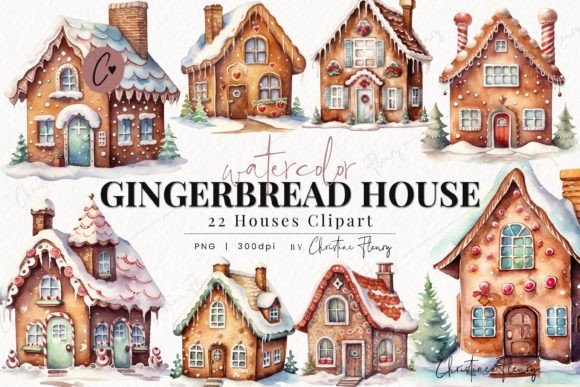
Watercolor Gingerbread House Clipart Review
First Impressions: Translating Paint to Thread
When I first opened the Watercolor Gingerbread House Clipart file, my immediate reaction was not just about the festive aesthetic, but about its potential as a functional machine embroidery design. As an illustrator category asset, this graphic carries a softness that is notoriously difficult to replicate in thread. Watercolor implies bleeding edges, transparency, and organic gradients, whereas embroidery is inherently structured and opaque. My designer’s eye immediately began dissecting the artwork to see if it could survive the digitizing process without losing its whimsical charm.
The mood of this illustration is undeniably nostalgic. It evokes memories of holiday baking and storybooks, making it a prime candidate for personalized gifts and heirloom-quality projects. However, from a production standpoint, I am looking at the contrast between the gingerbread texture and the white icing details. In a digital file, these blend seamlessly. In a finished product, they require distinct separation to avoid a muddy appearance. The visual personality here is gentle rather than bold, which tells me this design belongs on items meant to be cherished, not necessarily high-visibility promotional gear. It feels right for nursery decor, vintage-style aprons, or boutique holiday collections where the customer values artistry over loud graphics.
Real-World Application: The Holiday Tote Bag Test
To truly evaluate this Watercolor Gingerbread House Clipart, I mentally placed it onto a natural canvas tote bag intended for a small shop holiday collection. Canvas is a forgiving fabric with enough stability to hold complex designs, making it an ideal testing ground. For this specific tote bag design, I envisioned the gingerbread house centered, perhaps framed by simple holly leaves to anchor the composition.
In this scenario, the watercolor effect would likely be achieved through a combination of fill stitch and specialized shading techniques. If the digitization uses too many solid blocks of color, the "watercolor" illusion breaks, and it becomes a cartoon. I looked for evidence of stippling or varying stitch angles in the preview that suggest depth. On a cream-colored canvas, the warm browns of the gingerbread would pop, while the white icing details might need a subtle shadow outline to remain visible against the light fabric. This project highlights the importance of understanding how thread colors interact with the base material. A successful execution here results in a premium handmade product that justifies a higher price point because it looks like painted art rather than standard stitching.
Beyond totes, I can see this design performing exceptionally well in baby embroidery projects. The soft edges and non-aggressive color palette are perfect for onesies or nursery pillows. However, for sweatshirt embroidery, specifically on fleece or French terry, the textured fabric might compete with the delicate watercolor details. In those cases, I would recommend using a topping stabilizer to ensure the stitches sit on top of the pile, preserving the clarity of the icing lines and candy accents.
Navigating Fabric Limitations and Technical Risks
While the Watercolor Gingerbread House Clipart is versatile, it demands respect for technical constraints. Not every substrate is suitable for this level of illustrative detail. I would exercise extreme caution when attempting this design on stretchy knits or lightweight linen without proper preparation. The density required to mimic watercolor shading can cause puckering on unstable fabrics, distorting the house’s symmetry and ruining the professional finish.
Dark fabrics present another significant challenge. Watercolor art relies on light passing through layers to create luminosity. Dark navy or black fabric absorbs light, meaning you must stitch an underlay base (usually white) before applying the colored threads. This increases the stitch density significantly. If the embroidery file has not been optimized for dark garments, the result may feel stiff and bulletproof-like, which is unacceptable for wearable custom apparel. Always check if the provider offers a specific version for dark fabrics or if you have the software skills to add a knockdown stitch yourself.
Furthermore, consider the hoop size relative to the detail level. Shrinking this design down to fit a 4x4 hoop for a pocket patch or cap is risky. Watercolor nuances disappear at small scales; the icing dots may turn into indistinguishable blobs, and the roof shingles may merge into a solid mass. If your project requires a small footprint, verify that the design maintains legibility. Sometimes, less is more, and cropping a specific element of the house works better than compressing the entire scene. Similarly, curved surfaces like caps require distortion compensation that flat Illustrations often lack. Test on a curved surface scrap before committing to a production run.
Elevating Brand Value and Customer Trust
Using high-quality assets like Watercolor Gingerbread House Clipart directly impacts how customers perceive your brand. In the saturated market of Etsy sellers and craft businesses, generic clipart stands out negatively. A design that successfully translates the watercolor aesthetic signals to the buyer that you care about quality and artistic integrity. When a customer sees a printable mockup that accurately reflects the stitched outcome, trust is established. Conversely, if the digital preview looks painted but the physical item looks blocky, returns and negative reviews follow.
This design also enhances giftability. Holiday items are often purchased as gifts, and the emotional resonance of a gingerbread house taps into shared cultural traditions. For commercial embroidery businesses offering personalized services, this asset serves as a strong anchor for seasonal upsells. It pairs beautifully with custom names in script fonts, creating a balanced layout where the illustration provides the theme and the text provides the personalization. Just ensure you have confirmed the licensing terms for design assets before selling finished goods or digital files. Professionalism includes respecting intellectual property, which protects your business long-term.
Essential Designer Notes for Production Success
Before loading this digital embroidery file into your machine for a final project, adhere to these practical checkpoints:
- Test on Scrap Fabric First: Never assume the digitizer’s settings match your machine’s tension. Stitch out the design on the exact fabric and stabilizer combination you plan to use for the final piece.
- Analyze Stitch Density: Use your embroidery software to view the density map. If areas exceed 0.8mm overlap on lightweight fabric, reduce density or switch to a lighter fill pattern to prevent needle breaks and fabric damage.
- Check Thread Contrast: View the design in grayscale on your screen. If the gingerbread and icing values are too similar, adjust thread selection. You may need a darker brown or a brighter white to maintain definition that color alone cannot provide.
- Verify Stabilizer Choice: For watercolor styles, cut-away stabilizer is usually superior to tear-away because it supports the intricate shading stitches permanently. Use a water-soluble topping on textured fabrics like towels or fleece.
- Mockup Accuracy: When creating listings, use realistic textures in your printable mockup. Do not simply paste the vector art onto a shirt image. Show the stitch texture so customers understand they are buying an embroidered item, not a print.
- Licensing Confirmation: Double-check whether the license covers commercial embroidery for physical products versus digital redistribution. These are often separate tiers.
- Small Detail Inspection: Zoom in to 100% on the design file. Ensure running stitches outlining the icing are at least 1.5mm apart to prevent perforation and tearing during washing.
Ultimately, Watercolor Gingerbread House Clipart is a beautiful asset that bridges the gap between digital art and textile craft. By approaching it with a critical, technical mindset rather than just an aesthetic one, you ensure that your embroidery project honors the original illustration while standing up to the rigors of real-world use. Whether you are crafting a bespoke holiday gift or stocking your shop for the season, let practical judgment guide your needle.